Something funny is happening in the market right now.
Everyone is racing to add AI agents to their software. Copilots, assistants, agents — slapped on top of systems that were designed, from the ground up, for human users. The assumption underneath all of it is that we should just accept the premises of SaaS as they were written ten years ago.
We shouldn't.
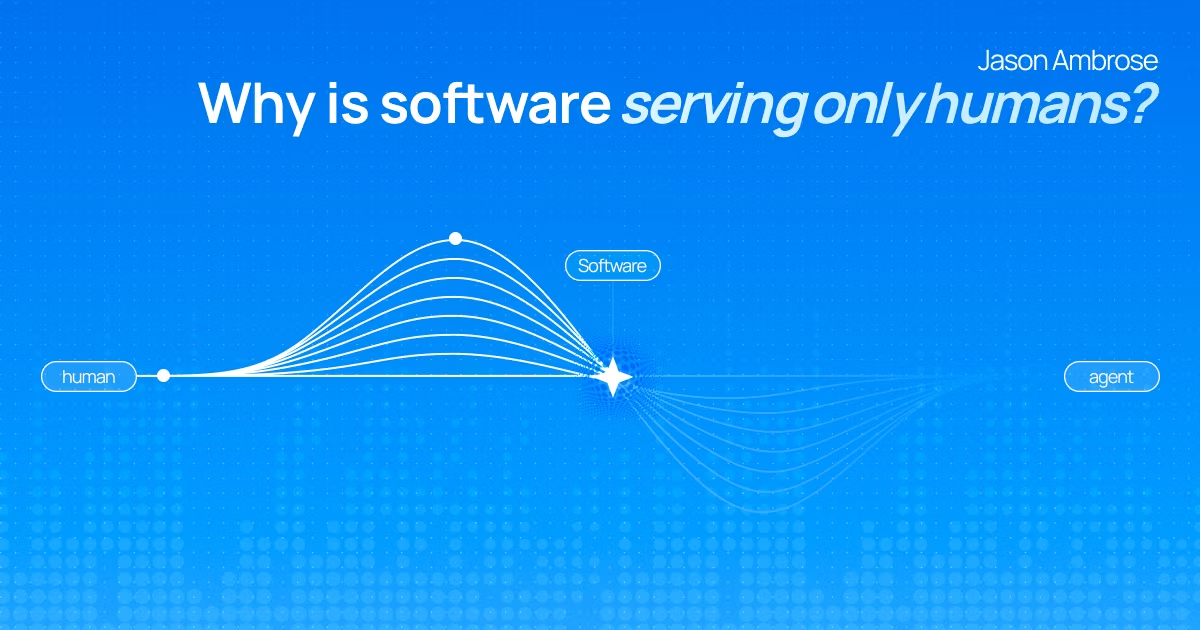
The software most enterprises run on was built for a specific user: a human being, logging in, clicking through menus, reading dashboards, entering data. That was the whole model. SaaS was "software as a service" where the service was delivered to a person.
Agents aren't people. They don't log in. They don't read dashboards. They need to pull context from across many systems at once, synthesize it, and then act on it. That's a fundamentally different access model than anything enterprise software was designed to support.
What's happening now is vendors trying to sneak AI in through a side door, letting agents peer through the curtain at data that was never structured for them. That's not going to work.
Why Reasoning Requires the Right Foundation
Here's why it matters: the true unlock with AI is that it can now reason. It can think through a problem, find a pattern, and come up with a solution. But to do that well, it needs the right context and the right information, served in a way that makes sense for how agents actually work.
Most vendors haven't rethought this. They're still building for maximum human visibility. Capture everything, present it to a person. The agent just becomes another consumer of a system that wasn't built for it.
The better model stops making customers decide what stays with humans and what goes to agents. That choice shouldn't be forced on anyone. The underlying capability, the data, the intelligence, the actions, should work regardless of who or what is consuming it. Human or agent. The process becomes fluid.
We're at a break point. The SaaS model is changing. Agents need to get information themselves, synthesize it, and have the agency to act. Software that can't support that isn't ready for what's coming.
The companies thinking clearly about this are redesigning their product experiences for both humans and agents from the ground up. They're asking "does our architecture actually support agents operating in it?" Different question. Better starting point.
Related Insights
Explore more expert insights on AI adoption, sales execution, and revenue intelligence to help your team close more deals with confidence.