

Sales has always demanded speed and results, but the pressure keeps intensifying. Higher quotas. Tighter budgets. Expectations that never stop climbing. For modern sales teams, AI isn't optional anymore, it's how you keep pace without burning your team out.
But being AI-ready isn’t just about the tools you buy. It’s about weaving it into your culture, data, and workflows. Most organizations today are testing AI in pockets, unsure of how to scale, and sales teams risk being left behind.
At People.ai, we help organizations move along the AI maturity curve from awareness to transformation, turning signals into actionable insights and embedding AI into your daily rituals. The first step? Understanding exactly where you are today.
Step One: Identify Your AI Maturity Level
In working with hundreds of revenue teams, I've seen five distinct stages emerge. Most organizations fall into one of the following:
- Not Started- AI is still viewed as hype. Processes are manual, data quality is inconsistent, and there's minimal appetite for experimentation. Teams rely on gut feel and relationships to predict outcomes.
- Awareness- Leadership recognizes AI's potential, but adoption is ad hoc. Individual contributors might use AI to summarize calls or prep for meetings, but there's no coordinated strategy. Insights don't make it into the systems teams actually use.
- Experimentation- Controlled pilots emerge. You might test AI-assisted forecasting, generate health scores automatically, or use AI to prioritize which accounts need attention. The question shifts from "Can AI help?" to "How do we scale this?"
- Scaling- AI is embedded in core workflows. Teams trust AI signals to drive high-impact actions. Interest grows around having tools work together in one place like MCP or API system-level access.
- Transformation- AI-first is a company-wide mentality. The organization has a multi-agent network in play, orchestrating GTM workflows autonomously. Innovation leads to proprietary AI models for competitive advantage.
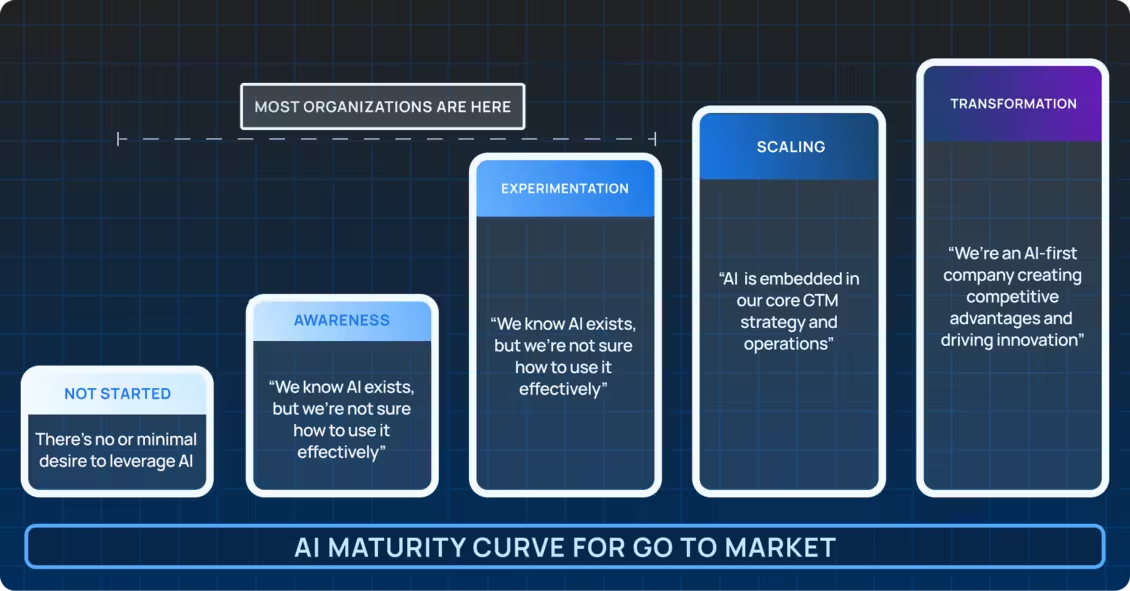
The majority of the organizations I work with today are in the Experimentation stages. However, Companies like Red Hat have successfully moved through these stages, consolidating fragmented planning processes and embedding their qualification frameworks directly into daily workflows. The impact can’t be overlooked. Red Hat has established a foundation for forecasting confidence that extends across their entire $6B+ revenue operation.
Step Two: Capture the Right Signals and Make Them Actionable
Once you understand your maturity stage, the next challenge is cutting through the noise. What do leaders really want? Answers and action. Signals are everywhere, but without context, they are basically worthless. The goal isn't to track everything, it's to identify the signals that predict real outcomes. That only happens when your data foundation is solid.
High-quality data isn't just a technical requirement. It's your competitive advantage. Even the most change-ready team can't succeed if the underlying data is broken.
AI models trained on richer, cleaner data deliver deeper insights and more accurate predictions. At People.ai, we've spent nearly a decade training our AI on billions of B2B deals. This is the kind of data that identifies patterns and fills in the gaps with ease and accuracy.
Red Hat is a prime example. With only around 30,000 contacts in their CRM for over 5,000 sellers, visibility into buyer engagement was minimal. New reps inherited accounts without context, leading to delayed ramp times and poor customer experiences. By automating activity capture and embedding qualification frameworks into CRM, they didn't just improve data quality. They made it effortless to maintain.
Step Three: Embed AI Into Workflows That Actually Matter
Personalizing AI for your teams is what separates organizations that experiment with AI from organizations that transform with it. This isn't about rolling out new dashboards or requiring people to log into another tool, it's about making AI seamless, automatic, and indispensable.
Audit your signals. Gather your leadership team and identify the metrics that best predict the outcomes you care about. For each metric, ask: "So what should we do when this signal fires?"
Create an AI manifesto. Define clear guidelines for how your organization will use AI- which decisions AI can inform, which it can automate, and which stay firmly in human hands. This isn't about limiting AI. It's about building trust by setting clear boundaries.
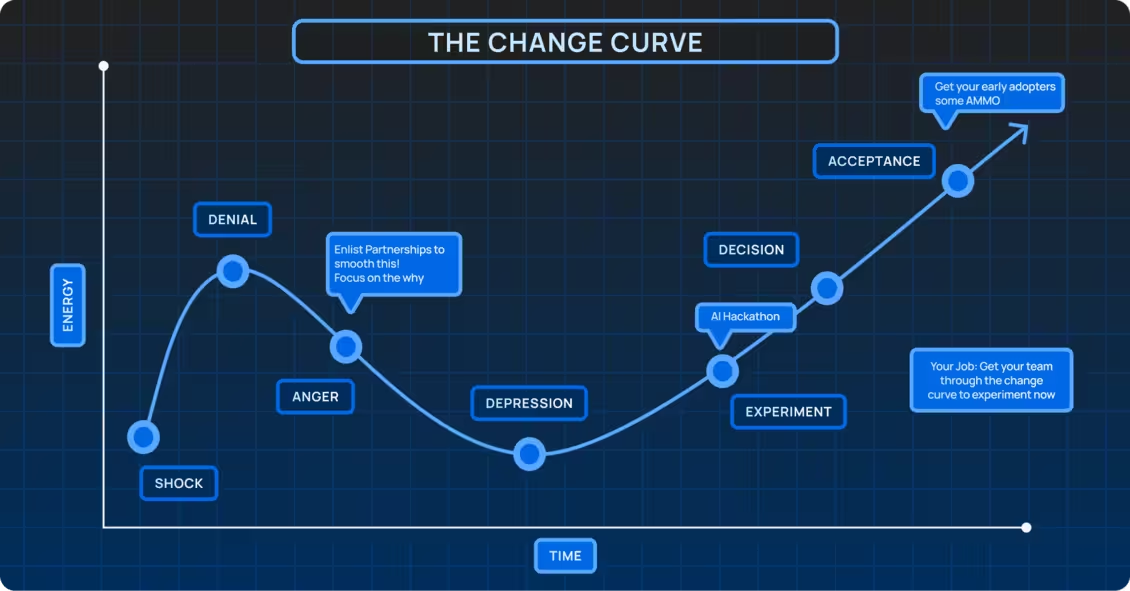
Host an AI Hackathon. Give teams a day to experiment with AI tools on real problems they're facing. No presentations, no proposals—just hands-on problem-solving. The goal is to surface creative use cases you wouldn't have thought of and identify champions who'll drive adoption afterward.
Encourage cross-functional collaboration. Choose a single initiative that's cross-functional, measurable, and solves a real pain point. Maybe it's automating risk identification. Maybe it's generating account plans. Start with one.
The goal isn't perfection. It's proving that AI works in your environment, with your data, for your teams. Pick one or two initiatives, execute them well, measure the impact, and then expand. The organizations that scale AI successfully don't try to transform everything at once. They build confidence through small wins.
Step Four: Guide Your Team Through the Change Curve
Adopting AI isn't just a technical challenge. It's a cultural one. You're asking people to change how they work, what they trust, and where they spend their time. Teams need to trust AI outputs before they'll act on them, and trust takes time to build. But there are ways to accelerate that trust.
To encourage adoption:
- Start with micro-experiments, not big-bang deployments. One high-value play (like using AI to orchestrate a critical renewal) can build momentum across the organization.
- Create fast feedback loops so teams see wins quickly. And, don’t forget to celebrate visible outcomes early and often.
- Make it clear that testing AI doesn't mean replacing human judgment. It means augmenting it.
- Don't dictate how teams should use AI. Instead, co-create plays across functions. Bring sales, success, and product together to design plays collaboratively.
As one Red Hat leader put it: "Until now, only managers submitted forecasts. This marks a massive shift in how we run our business, driving greater accountability, ownership, and commitment at the individual seller level." That kind of transformation doesn't happen through mandates. It happens through trust, iteration, and shared wins.
The Bottom Line
Being AI-ready isn't about buying the latest tool. It's about creating a culture where AI augments human intelligence, where signals become actions, and where insights are embedded into the workflows that drive measurable outcomes.
The question isn't whether to adopt AI. It's how quickly you can move from experimentation to transformation.
Start small. Focus on what matters. Scale with intention. Your team, your customers, and your business will benefit.
Related Insights
Explore more expert insights on AI adoption, sales execution, and revenue intelligence to help your team close more deals with confidence.