
Your prospect opens your email. Skims it for three seconds. Deletes it.
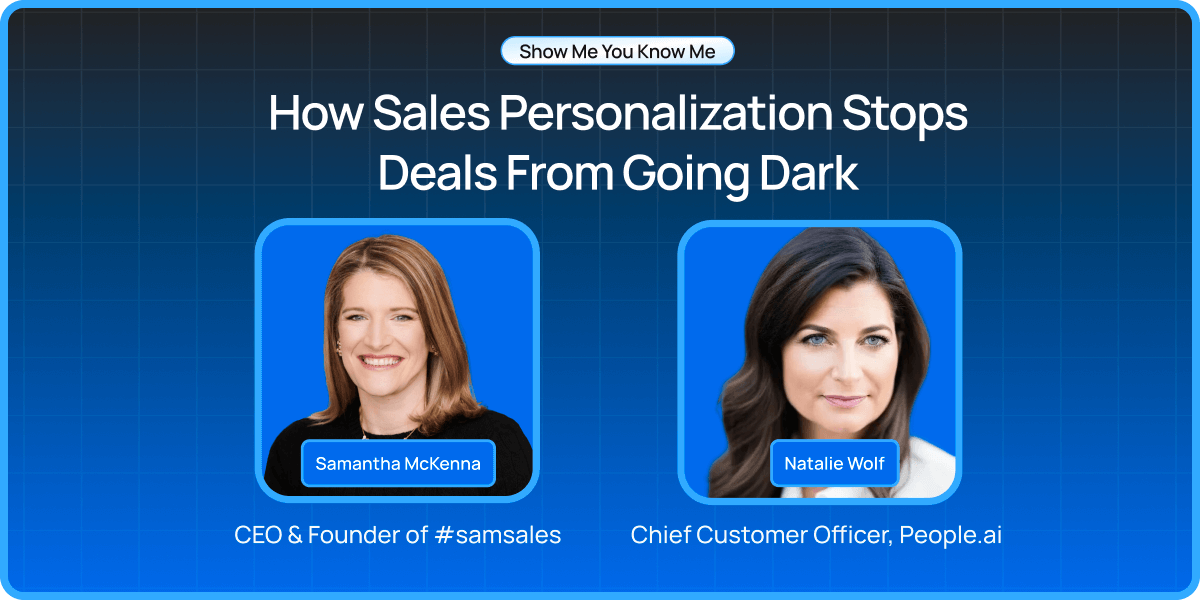
That's the reality for most sales teams using generic outreach. Natalie Wolf, Chief Customer Officer at People.ai, and Sam McKenna, founder of #samsales, sat down to discuss why sales personalization isn't just for cold emails. It's what saves deals at every stage — from first touch to renewals to damage control when something breaks.
Their recent webinar covered the strategies top revenue teams use to identify at-risk deals early and keep prospects engaged throughout the sales cycle.
Why Generic Sales Outreach Kills Deals Before They Start
Natalie cut straight to it: "The biggest lie in revenue is that discovery is a phase. Discovery is a continuous obligation."
Executives don't want generic pitches. They want to react to something smart. And you can't be provocative if you're uninformed.
Sam agreed: "We send crappy emails, we spray and pray, we scale and fail. That first email really matters. If it looks like everything else, they're not going to open the rest of your emails. You're building a brand as something that doesn't matter."
What Top Sales Teams Do Differently
Do your homework. Real homework. Not surface-level LinkedIn stalking.
Natalie shared what makes her delete versus respond:
- Pitches that ignore what my company actually does ("We help with revenue technology" when People.ai IS a revenue intelligence platform)
- Generic subject lines with no hook
- Emails with no hypothesis, no facts, no point of view
Bring a perspective. Show you understand their challenges. Make them think.
Sam's take: "You need to prove value in that email. Show that time with you will be well spent."
Short Emails vs. Smart Emails: What Actually Works
Here's where Sam pushed back on conventional wisdom.
"I've always heard we have to keep emails super short. 50 words or less. Subject lines can only be two words. Write emails in the shape of an F. I don't know where all this comes from."
Her point: If 10 people send the same short, generic email, the prospect can't say yes to all of them. They'll say yes to the one that proves the sender has a brain.
"My theory is you're going to say yes to the email that's longer and proves they can help you. Not just 'I saw this, we can do it, interested in a chat?'"
Natalie confirmed: "I'm totally going to swipe right on the person who makes me feel special and like they know me."
The takeaway? Sales personalization isn't about keeping it short. It's about being relevant.
How to Create Peak Moments That Save At-Risk Deals
Natalie referenced one of her favorite books, The Power of Moments, to explain why peak experiences carry entire relationships.
"Peaks can elevate the entire customer journey, but they don't happen by accident. They're created by people, processes, and tools."
She gave real examples:
- Knowing a customer's exec team is at an offsite in Florida and sending a note with three specific goals for the partnership. Now you're top of mind during strategic planning.
- After a bad experience, writing proactively to say: Here's what broke. Here's how we're fixing it. Here's how I'll make sure it never happens again.
"A few peak moments can carry you through all the boring just fine," Natalie said.
When Problems Surface: How to Save Deals in Trouble
Sam asked Natalie a pointed question: "When a problem comes up with a vendor, what does their behavior need to be to save that deal?"
Natalie's answer: "It's fine to just close the support case and have the CSM do the thing. But to create a peak, I want to see the path forward beyond this moment."
She broke down what that looks like:
- Show how you're fixing the immediate issue
- Show how you're preventing it from happening again
- Give visibility into what's next
Sam added context: Most vendors disappear when things go wrong. The ones who show up, own it, and explain what's changing? Those are the vendors who keep customers.
Give Your Reps a Budget for Personalization
Someone asked during the webinar: "Do you have a dedicated budget for your teams to purchase small items for customers?"
Sam's response was blunt and practical:
"Give your reps a $250 to $500 annual budget. They can expense it, no approval needed. Empower them to buy anything that helps accelerate a deal."
Examples from Sam's team:
- Custom guitar picks when they saw a prospect had a guitar in their Zoom background
- A bag of rubber duckies when a prospect said "I need to get my ducks in a row"
- An excavator toy when someone mentioned "moving boulders" before tackling a proposal
"Nobody does it," Sam said. "But the value of not having to ask permission every time is huge."
Natalie tied it back to process: "The Four Seasons gives every employee a certain threshold to make an experience great. We can do that for enterprise software."
AI in Sales: Help or Hype?
The question came up near the end: Is AI actually helpful, or is it just noise?
Natalie didn't hedge: "It's hype if it replaces thinking or if it's shallow. But it helps if it preserves context and reduces risk at scale."
Sam agreed: "AI sales tools are going to make you smarter. They're not a silver bullet. Use them to speed up your resourcefulness. But if you rely on them to do all the hard work you don't want to do, you're just going to be like everybody else."
What Should Every CSM Ask to Prevent Deal Slippage?
Natalie left the audience with a question she believes every Customer Success Manager should ask in QBRs:
"What would make this partnership feel like a no-brainer a year from now?"
Why this works:
- It assumes change (because there always is change)
- It surfaces risk tied to organizational shifts
- It gives you an opening to understand what's next and make a moment matter
"Ask the hard questions," Natalie said. "Walk through the pain early."
The Long-Term Value of Sales Personalization
Sam closed with this:
"You've got to decide what kind of seller or leader you want to be. What's your brand going to be? Is this something you're doing for the long haul?
I've been in sales almost 20 years. Buyers I had back in 2010 are clients at #samsales now. Small actions matter. Do you want to be a cut above everybody else, or do you want to be just like everybody else?"
Sales leaders are tired of generic advice that doesn't work. Sales personalization saves deals at every stage. When you show up informed and willing to create peak moments, you stop losing opportunities to competitors who don't care enough to try.
Related Insights
Explore more expert insights on AI adoption, sales execution, and revenue intelligence to help your team close more deals with confidence.
.avif)
